MobilityTwin-PT (OPDTwin)
An open-source digital twin platform for public transport systems.
MobilityTwin-PT enables the creation of interactive digital representations of public transport networks using open data. It transforms network, operational, and built environmental datasets, as well as simulation outputs into a structured digital twin that can be explored, analyzed, and extended for research or planning purposes. The platform is designed to be transparent, modular, and reproducible — lowering the barrier to developing digital twins for public transport.
What It Does
MobilityTwin-PT provides:
- Automated processing of open transport data (e.g., GTFS)
- A structured digital model of routes, stops, and services
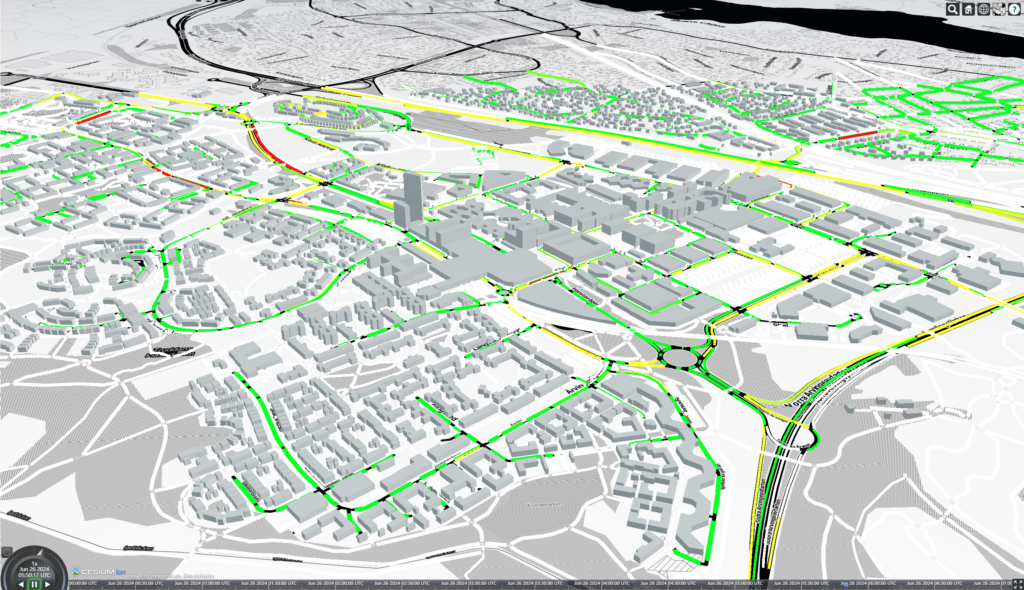
- An interactive web-based visualization interface
- A backend architecture that can connect to simulation and analytical tools
The layered design allows the digital twin to serve both as a visualization environment and as a foundation for model integration.
Use Cases
MobilityTwin-PT can be used to:
- Explore and visualize public transport networks and operations (Nowcasting/Monitoring)
- Collection and analysis of historical data (Retrospective/Understanding)
- Prototype service or network changes integrating with simulation (Forecasting/Planning)
- Support teaching and demonstration of digital twin concepts, and extendable integration of computing models
The platform was demonstrated in a real-world case study in Kista, Stockholm, showing how open data can be transformed into an operational digital twin environment.
Open Resources
Software (Open Source)
https://github.com/MobilityInformaticsLab/opdtwin
Documentation
https://mobilityinformaticslab.github.io/opdtwin/
Scientific Publication
https://www.sciencedirect.com/science/article/pii/S1077291X26000032
Contacts
Jonas Jostmann (jostmann@kth.se), Tong Mo (tong33576@gmail.com), Zhenliang Ma (zhema@kth.se)
MobilityTwin-PT was developed at the Mobility Informatics Lab, KTH Royal Institute of Technology, with support from Digital Futures and the Senseable Stockholm Lab (a collaboration between Stockholm Stad, KTH, and MIT).